That Still, Small Voice
What ever happened to listening to our conscience?
We all have a still, small voice that calls to us and shows us what’s important. It is a feeling in our gut that tells us when something feels off or doesn’t feel right. Yet, some of us have learned, over time, to bury it, ignore it, and diminish its significance.
When I was a child, my conscience was pretty well developed. I was attuned to that still, small voice and I did my best to pay attention to whatever it was trying to tell me. In my teenage years, it was no longer considered “cool” to listen to your conscience. I noticed that every time I felt some kind of way in my gut, about a situation, I would be faced with peer pressure if I went against the grain or opposed the social norms of the times. So I began to push away that still, small voice, instead of facing the rejection of my peers.
My mother wouldn’t allow me to watch certain movies or listen to certain rock music, and kids made fun of me and bullied me for being a “goody two-shoes.” I very quickly noticed it was not “cool” to read the Bible or be a Christian among my peers. So I slowly began to hide those aspects of my life, and felt ashamed of my love for God, and my attempts to have a good conscience. I started smoking weed and drinking, because it made me seem “mature and rebellious,” which was deemed acceptable. Lying and disobeying my parents was another way I obtained social approval, since it appeared like everyone was doing it. It wasn’t true. I saw other girls getting shamed for not giving in to peer pressure as they fought for their moral standards. I secretly admired them, knowing I didn’t have the courage to do what they were doing, since I craved social acceptance more than integrity.
I was hesitant to do the right thing and defend friends who were getting bullied or mocked, knowing I faced the risk of having everyone else turn against me. Growing up is difficult; my ethics and morals really got tested thanks to my need and desire to be validated and socially accepted into modern society. It is unpopular to be virtuous. Even being a good student was a constant source of teasing for me. Students made fun of me for completing my homework assignments on time and raising my hand to answer the teacher’s questions. It was almost impossible to avoid being mocked or constantly attacked for doing the right thing. Over time I finally decided to sacrifice my values and ethics in exchange for social acceptance. It was a slow erosion of my belief in God that culminated in my total rejection of God as I entered my college years and embraced the freedom and vanity of becoming a young adult. That’s when I developed the skills of keeping the balance, the dance of Dr. Jekyll and Mr. Hyde; I learned how and when to don the mask, and developed a persona: the wild, crazy party girl that blacked out every weekend, while still trying to keep the real version of me alive: the college student that got all A’s. What I didn’t realize was that the lines were blurring, I no longer knew which was the mask and which was my real self.
Eventually I decided to fully embrace and succumb to the image I had created of myself: the charming drunken artist that everyone seemed to like. My validation and identity was obtained through this persona, but inside I was empty, miserable, and starved for real love. I wanted truth, but I didn’t know where to start looking.
This took me on a long journey I did not expect. In my blindness, I was trying to numb my shame and guilt through alcohol, sex, and drugs. I was trying to push away the shame, and pretend my sins were non-existent. I couldn’t sleep at night because of all the anxiety and paranoia. My drinking and recklessness got worse as my persona and ego grew bigger. At this point, that still, small voice was barely a whisper. It became a sensation I no longer recognized and did not trust. I didn’t know where to turn to for help, I was extremely confused. I considered myself an artist and was continually trying to push the boundaries of what art is. I craved attention and wanted to get some significance and recognition through my art. I discovered performance art and conceptual art. Looking back, the performances I created were rituals of destruction and self-destruction glorifying chaos, danger, and death. I became a narcissist, queen of the weird and the interesting. People told me they admired my strangeness and my ability to not care what people think. It was actually the complete opposite. I adored it, and although I thought I was being authentic, I was really driven to do what I believed people wanted. I was the ultimate people-pleaser, and I didn’t know who I was. My identity was fractured. I was all these different facets of a self, but they felt fake, as if I was really nothing at all. I dragged this fractured self with me, all throughout my twenties, through different countries, and could not escape myself. I could not look at myself in the mirror. The picture of Dorian Gray is real. I lived it.
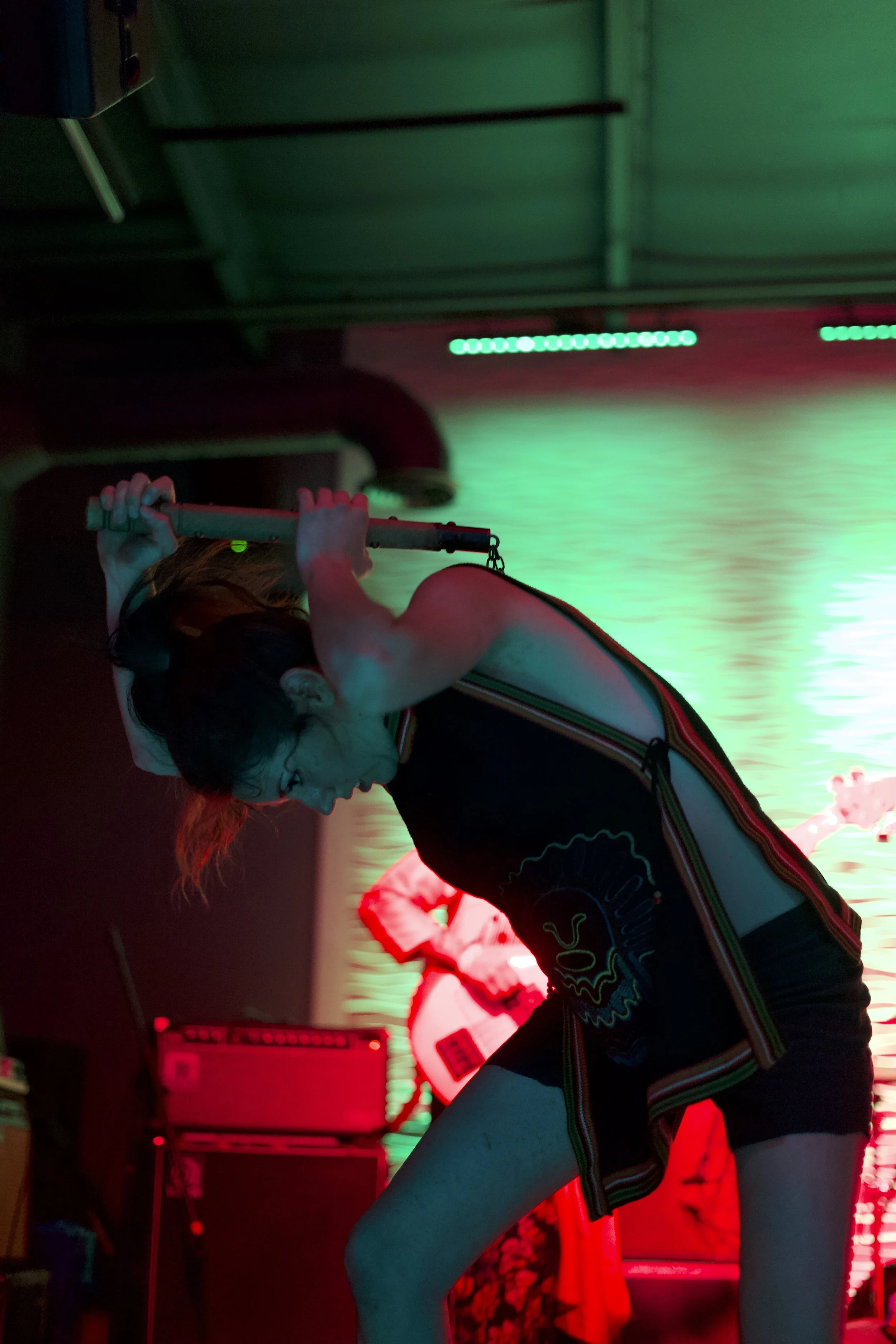
Photo by Ricardo Castro
I became obsessed with broken glass. I worshipped it because I was like that broken glass lying in pieces on the floor: hopeless. It was so captivating to me, although I knew deep down that broken glass is just trash, I exalted it. I started collecting the pieces I would find, lots of broken mirrors left out on sidewalks and front lawns. I took them home and created a shrine in my room. Only broken mirrors and broken glass were allowed. I placed them under my bed. When a lightbulb broke in my hand, causing me to bleed; I would get turned on by the mixture of blood and broken glass. I often masturbated to the thought and image of broken glass. When I got drunk at the clubs, whenever a glass would break, I would tell everyone to stop dancing, I’d stoop down, pick up the pieces and put them in my mouth. I began doing performances with a rock band where I would dance on a mirror, jump on it to break it, and then eat the broken pieces. At parties, when a glass would break, I’d get down on my knees and pick up anything that was translucent, and put it in my mouth. It was a game I called: Is it ice or glass? My friends thought I was insane and hardcore. Now I was flirting with death, playing a game that I would not win. I performed onstage, sliding knives along my tongue, tying a rope around my neck. People always ask me if my insides ever got cut up while doing any of this. The answer is no, I never did. I know it was a miracle that every single time I did something crazy I somehow survived things that could have easily sent me to the emergency room. I used to tell people “There is some kind of energy that is protecting me when I’m doing this. I can feel this energy keeping me from harm.” The truth is that God was watching out for me each of those times. Deep down, a part of me wanted to die, I probably felt like I deserved death due to all the shame I carried inside. I’m sure many of those times I was hoping that I would die, but God had other plans for me.
Around that time, a few people I knew died. One died of an overdose, another committed suicide, and the third died of AIDS. In his addiction to meth, he chose to go get more drugs instead of showing up to his medical appointment. He died the day after my birthday in 2022; I was in Arkansas doing a performance art festival. It took me a long time to process his death; he was one of my best friends from high school. I then broke my ring finger during a blackout, I still have no idea how it happened. That’s when I decided “I can’t stay in this same spot anymore, if I do, I’m going to end up dead.”
At a film festival, I bumped into my cousin Oscar Avila. He’s been sober almost twelve years now. He didn’t know me very well, but I pointed at him saying “you’re my cousin, your mom is the daughter of _____ and my mom’s mom is her sister!” He didn’t believe me at first, but knew I was right. Here I was with a drink in one hand, and my head hanging backwards out the window, as usual. He didn’t find my antics funny at all; when I asked if he wanted any wine, he told me “No thanks. I’m nine years sober and I’m perfectly fine without a drink.” He meant it; he looked radiant and full of something I did not have. I wanted to find out what was missing from my life, that of which he seemed to have full access. That thing was Jesus Christ. He didn’t tell me that at the time. He did tell me to join him for coffee the following day.
We actually went to a bar, and I ordered a club soda. We talked for a few hours. He told me he had been in rehab, and how much he hurt his family and friends with his addiction. He asked me if I blacked out. “All the time,” I said, proudly. “That’s not normal. Do you try and control how much you drink?” I was shocked, “Yes, in fact I do try and control the amount of drinks I have, and I’ve tried to stop for a few months. It never works.” He then told me about AA and invited me to a meeting. I was horrified and offended, and said “No thank you. I’m not what you think I am.” He tried a few other times. I finally went one evening, and I was disgusted when I saw the word GOD on the wall. I sat there with my arms crossed, fuming. I told myself “What a fool! He thinks I’m an alcoholic.” In reality, I was the real fool. As I sat in the meeting, I heard the word humility for the first time in many years. I forgot what it meant. I listened to the shares and stories, but my pride wouldn’t let me see or admit that I belonged there. I went back the next day, and then the day after that; I’ve been sober ever since. Next month I will be three and a half years sober. I still can’t believe it. The change didn’t happen over night; that’s the beautiful part. It has been a daily choice, paired with a willingness to grow, that has allowed me to change my mind about a lot of things I thought I had already figured out. It was a complete submission to the will of my Creator that ultimately changed my life for the better. Looking back, I fought so hard to keep my persona, I resisted God in so many ways. I still do, on certain days, in my weak moments.
There was even a point when I thought killing myself would be easier than submitting to God. It is a daily battle. He has really chiseled away at my pride, my rebellion, and my heart; but I found the love and comfort that I had been searching for, my entire life, in the arms of Jesus Christ. The validation I was seeking was instantly given to me as a gift when I came to understand the atonement and the significance of what Jesus did on that cross. There are moments that I still can’t wrap my mind around its depth. My anxiety and paranoia have dissipated completely. I found my identity in Christ; he has restored me to wholeness. I am a different person now; a version of myself I hardly recognize: a more loving, honest, and humble version. He has showed me that he has been with me since the very beginning, and that he has never really let go of my hand throughout any of my tribulations. He is in control of everything; my only job is to heed that still, small voice, and trust his timing, his wisdom, and his will.